
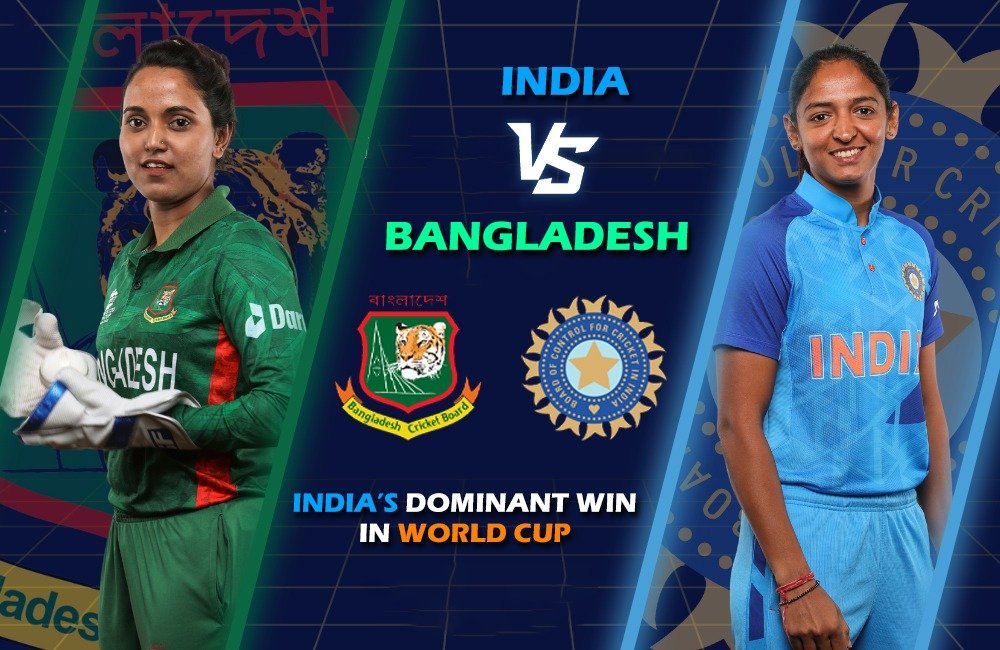
During the ICC Women’s World Cup, the India vs Bangladesh Women’s match was a crucial contest, with both teams striving to earn the maximum points and strengthen their position in the tournament. The Indian team displayed the most determination, focus and determination to win. Bangladesh on the other hand could have a chance to demonstrate their skills in the incredibly important field that is women’s cricket. The competition, specifically to the constantly changing female cricket landscape, was certainly in the air and for all legitimate reasons. The nearly evenly matched match quickly changed the game for women’s cricket. for more info: online cricket ID
A Good Beginning and a Difficult Middle
The day was sunny in Hamilton and India was the first to win at. In the first innings, India’s openers, Smriti Mandhana and Shafali Verma, wanted to make a great start. New bowlers from Bangladesh were accurate in their swinging, only enough to create an issue. Both Indian openers displayed a great deal of patience, allowing the ball to rest to score runs.
Bangladesh’s new-ball teammates were becoming more accurate which gave the batters no trouble to score runs. Finally, the first wicket fell to Bangladesh. After Shafali’s wicket was taken, India was put on the back foot. Then came Yastika Bhatia and scored her anchor 50 runs the middle order India had standby. Whenever the middle order was getting runs, she made sure the runs came simple so it wouldn’t be easy for the opposing team. She made it so the middle order would not get runs in a diffused manner.
As the score rate slowed , it was Sneh Rana’s 27 runs which led India to the game with a score of 229/7. The 27 runs made it so Bangladesh’s resourceful spinners would take control of the game.
Spin Takes Center Stage
In attempting to reach the target of 230 runs, Bangladesh made a slow and deliberate beginning and saw Murshida Khatun as well as Sharmin Akhter putting up a bit of resistance against the ball. However, it didn’t last long to allow the remaining Bangladeshi batters to be caught in the trap created by Indian spinners. While Deepti Sharma remained in the choke grip at the other end of the field the accuracy of the bowling by Rajeshwari Gwad was admirable. After that came Sneh Rana and she was the pivotal moment of the game.
Rana’s spell of 4 for 30 was the most disruptive and during the chase her teammates’ fielding was so poor that they seemingly lost all will when she kept taking wickets. Bangladesh was, to all intents and purposes, hopelessly stuck 80 for 6 by the halfway mark.
Bowling to defend a low score, the Indian bowlers were quick to take the initiative while the Bangladeshi bowlers were very sharp. The fielding also did not drop at any point. All of this led to the final result of Bangladesh being bowled all out for 119, thereby losing the match by 110 runs.
Lessons and Legacy
For India, this was not simply about gaining another two points on the table. It was about proving calmness, showing depth, and demonstrating intent. Given the team’s ups and downs earlier on in the tournament, this was the confidence booster we needed. It proved that the team has a balance. The maturity shown by Yastika, the collective bowling efforts, and dual magnificence of Sneh Rana are all signs of a team peaking at the right time.
For Bangladesh, the result was disappointing but the match was of high importance. The bowling continued to show inconsistency and tactical awareness and in contrast the batting faltered, and once again partnerships were purely tactical. The difference between the level of performance and the potential was obvious but their early fight proved that they are no longer pushovers in the world of cricket.
The Wider Significance
Another motivational source, the impact of matches like India vs Bangladesh, keeps growing with the continued rise of the game globally. It is no longer just women’s cricket, but also the overall game. It’s no longer just a game between opponents; it is a game of dreams. Nations are inspiring a new generation of players by pushing the limitations of sport.
The achievement of Bangladesh was a recognition of their status as women’s cricket powerhouse, a reminder boost to their campaign. For Bangladesh, this achievement was another recognition as a cricketing/select a new competitive world cricketing period.
India had it all, and skill, strategy, and confidence were key. But it was no longer just India, it was the sport of women’s cricket and all it had to offer the world: unmatched brilliance, insatiable drive, and an unprecedented rise in all forms of the game across Asia.